
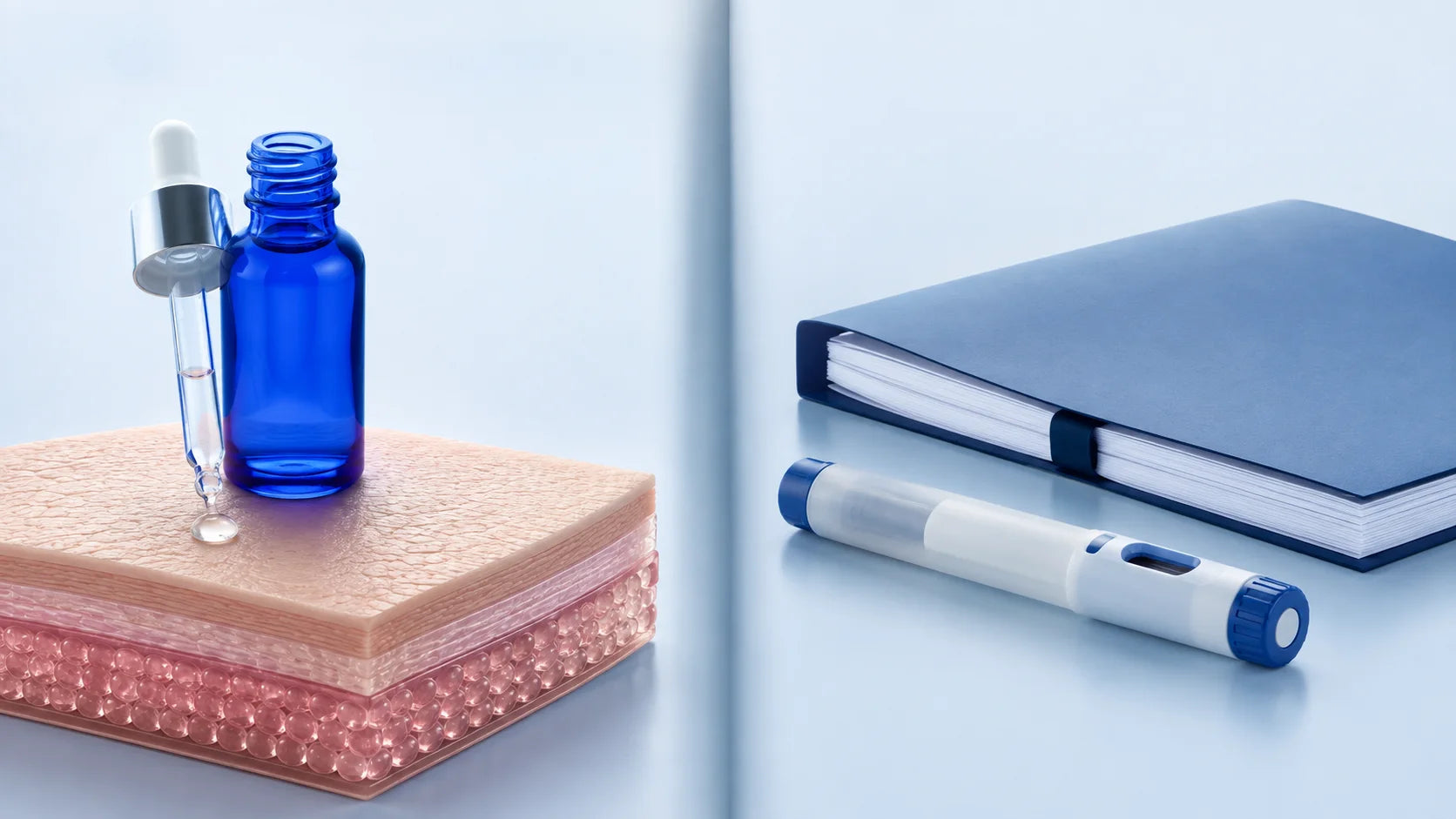
PT-141 and bremelanotide are two names in one development history
PT-141 was the development name used for the cyclic peptide now known as bremelanotide. FDA review materials describe bremelanotide as a synthetic melanocortin analog and a nonselective agonist at several melanocortin receptor subtypes.
Identity is only the first layer of evidence. A useful comparison must also match the chemical form, finished formulation, route, amount, exposure pattern, population, and endpoint. Two products can name the same active peptide while differing on nearly every other variable.
Sources for this section: FDA multidisciplinary review of bremelanotide
What the FDA-approved product actually is
The current DailyMed label identifies Vyleesi as bremelanotide injection for subcutaneous use. Each labeled dose contains 1.75 mg of bremelanotide in 0.3 mL. It is a prescription drug with a specific indication, limitations of use, contraindications, warnings, and administration instructions.
That approval belongs to the labeled drug product—not to the peptide name in every possible preparation. VitaPep PT-141 Serum is not Vyleesi, is not an injectable product, and is not represented as a treatment for hypoactive sexual desire disorder or another medical condition.
Sources for this section: Current DailyMed label for Vyleesi
The pivotal human trials used subcutaneous injections
The two Phase III RECONNECT trials randomized 1,267 premenopausal women and evaluated 1.75 mg bremelanotide administered subcutaneously as needed for 24 weeks. The trials reported statistically significant differences from placebo on their co-primary desire and distress endpoints. Nausea, flushing, and headache occurred more often with bremelanotide.
Those results answer a route- and population-specific drug question. They do not show how much PT-141 crosses intact skin from a topical serum, whether exposure is local or systemic, what topical amount would correspond to an injection, or whether the same benefits and risks occur with a different finished formula.
Sources for this section: RECONNECT Phase III trials (PubMed)
Route changes what evidence is needed
| Evidence question | Prescription evidence | Topical evidence needed |
|---|---|---|
| Administration | Subcutaneous injection using the labeled autoinjector | Defined application to intact external skin using the finished serum |
| Exposure | Pharmacokinetics measured after a known injected dose | Dermal penetration and any systemic exposure measured for the topical formula |
| Safety | Warnings and adverse events tied to the approved drug and study population | Local tolerability and other safety outcomes for the topical formula and use pattern |
| Outcome | Drug endpoints in diagnosed premenopausal women | A defined, lawful endpoint supported by a study of the finished topical product |
What safety information should remain attached to the prescription route
The prescription label includes a contraindication for uncontrolled hypertension or known cardiovascular disease and describes transient increases in blood pressure after each dose. It also reports nausea, flushing, headache, injection-site reactions, and focal hyperpigmentation among labeled safety considerations.
These facts should not be copied onto a topical product as though they predict its risk profile. They show why route-specific exposure matters and why a topical product cannot borrow an injectable drug’s benefit claims while discarding its formulation, medical supervision, contraindications, and warnings.
Sources for this section: Current Vyleesi prescribing information and warnings · Ambulatory blood-pressure study (PubMed)
What applies to VitaPep PT-141 Topical Serum?
- The current product record lists PT-141, also known as bremelanotide, in a ready-to-use topical cosmetic serum.
- The listed amount is 25.5 mg in a 30 mL bottle; batch PT141010 testing reported 0.85 mg/mL for the submitted sample.
- The listed carrier is 70% DMSO and 30% deionized water.
- Published testing documents address identified sample characteristics; they do not establish dermal absorption, systemic exposure, clinical effectiveness, or prescription-drug equivalence.
- The intended use is topical external cosmetic use only. Do not inject or ingest the serum, and do not use it as a substitute for prescribed medication or medical care.
A responsible PT-141 evidence checklist
- Name the exact finished product and route before discussing a study result.
- Keep FDA approval, dosing, indications, and warnings attached to the prescription injection.
- Do not convert an injected dose into a topical amount without validated topical pharmacokinetic evidence.
- Ask whether a topical claim is supported by the finished formula rather than the ingredient name alone.
- Treat sexual-function, disease, and body-function promises as drug claims—not cosmetic product facts.
Continue your research
FAQ
Frequently asked questions
Are PT-141 and bremelanotide the same peptide?
PT-141 was the development name for the peptide now known as bremelanotide. A shared active-peptide identity does not make different routes and finished products interchangeable.
Is VitaPep PT-141 Topical Serum the same as Vyleesi?
No. Vyleesi is an FDA-approved prescription bremelanotide injection. VitaPep PT-141 Serum is a separate topical external-use cosmetic with a different formulation, route, and intended use.
Do bremelanotide injection trials prove a topical PT-141 effect?
No. The pivotal trials studied a 1.75 mg subcutaneous prescription dose in a defined patient population. They did not measure delivery, safety, or outcomes for a topical PT-141 serum.
Can an injection dose be converted into a topical PT-141 amount?
Not from the available evidence. A route conversion would require validated data on dermal penetration, bioavailability, exposure, and safety for the exact topical formula.
Is VitaPep PT-141 Topical Serum injectable?
No. It is presented only for topical external cosmetic use. Do not inject or ingest it.
Selected authoritative sources
These sources are provided so you can inspect the study type, molecule, route, and limitations directly. They do not endorse a VitaPep product.